27 Jun 2026
Weather Shifts Reshaping Outdoor Event Odds and Their Ripple Into Arena Markets

Atmospheric conditions have long dictated outcomes in open-air competitions, yet the ways they recalibrate betting lines continue to evolve. Temperature swings, precipitation rates, wind velocities, and humidity levels each exert measurable pressure on performance metrics across tennis, golf, baseball, and thoroughbred racing. Those adjustments flow directly into probability models that oddsmakers employ, and observers note the downstream pressure this places on enclosed venue markets when bettors migrate indoors.
Take tennis as one clear case. Heavy rainfall on grass courts slows surface speed and reduces serve effectiveness, which compresses the margin between favorites and underdogs. Data from major tournaments shows that matches played after overnight storms produce higher rates of service breaks compared with dry conditions. Bettors who track these patterns adjust their stakes on set totals and game spreads accordingly, while sharp operators widen or narrow lines in real time to balance exposure.
Key Variables and Their Direct Effects
Wind remains the most disruptive single factor in golf and baseball. Gusts above 15 mph alter ball flight trajectories enough to shift driving distances by 10 to 15 yards on average, according to performance studies compiled by the PGA Tour. In baseball, crosswinds at open stadiums increase the frequency of fly-ball outs in certain directions while suppressing home-run totals. Oddsmakers incorporate these variables into run totals and player props, creating noticeable line movement once forecasts solidify 24 to 48 hours before first pitch.
Humidity compounds these issues in both sports. High moisture content reduces effective lift on baseballs adn increases fatigue among players during extended rallies in tennis. Research published in the Journal of Sports Sciences demonstrates measurable declines in serve velocity when relative humidity exceeds 70 percent, prompting market makers to shade totals downward in affected matches.
Carryover Pressure on Enclosed Markets
When outdoor events face delays or cancellations, wagering volume frequently migrates toward basketball, hockey, and indoor tennis. This shift alters liquidity and line stability in those arenas. During periods of sustained poor weather across major European and North American circuits, operators report elevated handle on NBA player props and NHL period totals as bettors seek alternatives. The increased action can compress margins on popular markets while opening value elsewhere as books manage inventory.
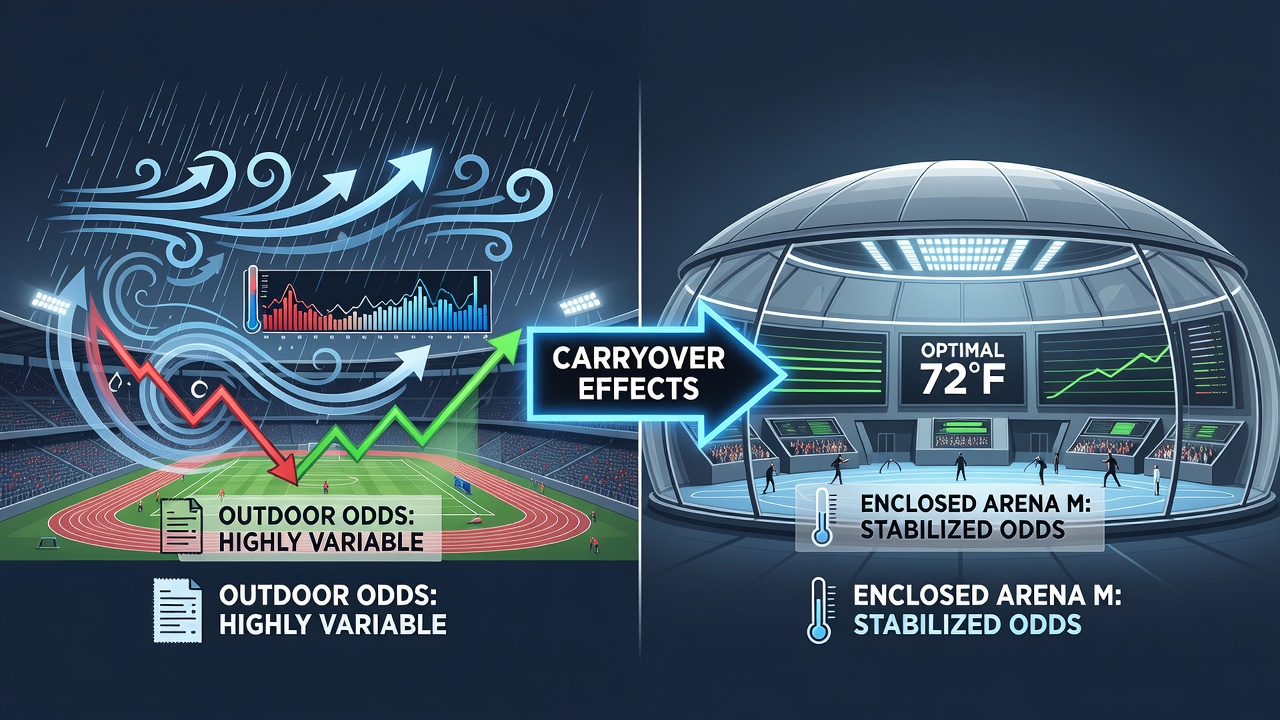
June 2026 provided a recent illustration. Prolonged rain across the British Isles and parts of the eastern United States postponed several high-profile golf and tennis events, pushing daily turnover into evening basketball and volleyball fixtures. Lines on those indoor contests moved more than usual as operators absorbed the redirected flow, with several player-performance markets showing volatility that persisted into the following week.
Modeling and Market Response
Advanced weather integration now forms a standard component of modern odds compilation. Firms combine real-time meteorological feeds with historical performance databases to generate adjusted probabilities hours before events begin. When forecasts indicate elevated wind or precipitation, totals markets often open lower than seasonal averages, then adjust further once actual conditions materialize. Bettors who monitor forecast revisions can identify discrepancies between initial lines and updated projections.
Industry organizations such as the National Oceanic and Atmospheric Administration supply granular data that feeds these models. Academic work from institutions including the University of Exeter has examined how precipitation thresholds correlate with changes in match duration and scoring rates across multiple sports, offering quantitative benchmarks that operators incorporate into their frameworks.
Regional Variations and Seasonal Patterns
Geographic differences matter. Venues in coastal or mountainous zones experience more frequent wind impacts than inland sites, producing consistent biases in home-team performance metrics. Seasonal transitions also matter: spring and autumn shoulder periods generate the widest variance between forecast and actual conditions, amplifying line movement once play begins.
Those who follow these patterns often build decision trees that layer weather variables onto baseline statistics. The result is a more dynamic pricing environment where outdoor events set the tone for broader market activity across both open and enclosed competitions.
Conclusion
Weather variables continue to function as primary drivers of outdoor competition pricing while simultaneously shaping liquidity patterns in arena-based markets. As modeling tools grow more precise and data feeds more granular, the interconnection between atmospheric conditions and betting lines across venues becomes increasingly explicit. Observers tracking these relationships gain clearer insight into how one market segment influences another when forecasts shift.